Exa Capital Named to the Inc. 5000 List for the Second Consecutive Year
August 20, 2026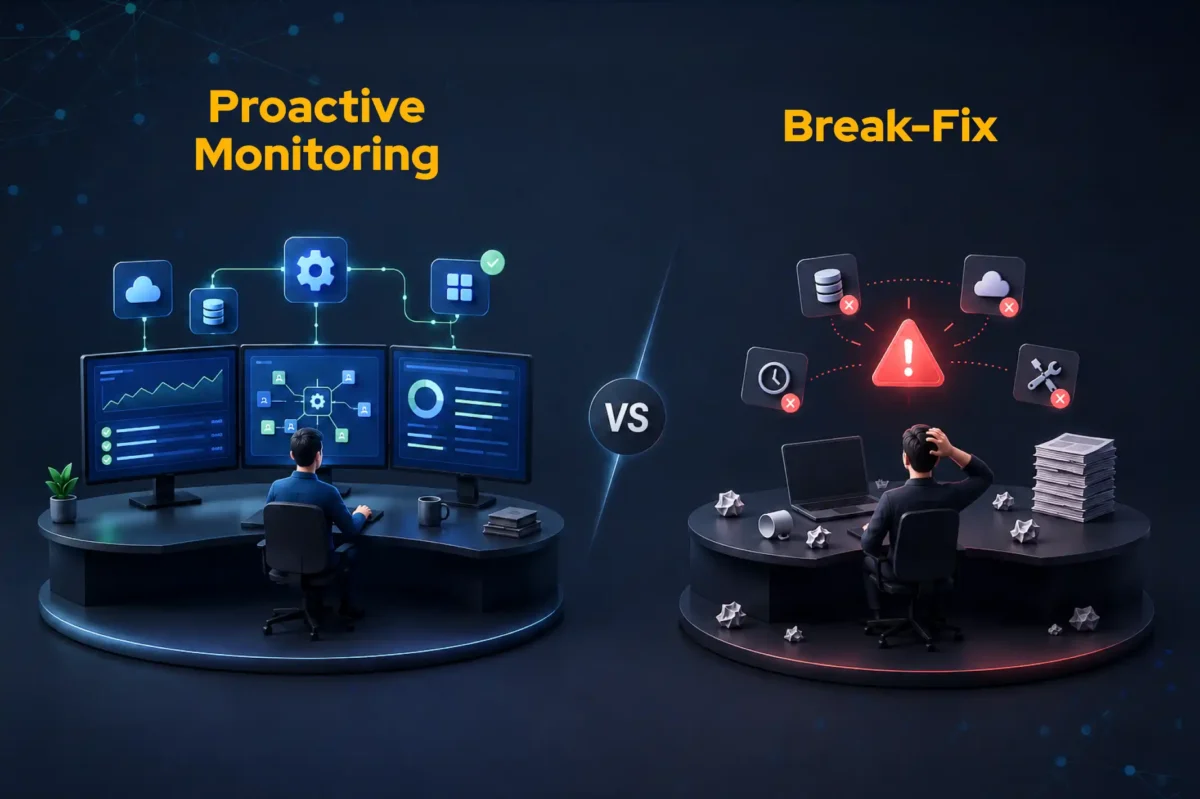
For the operators who find out from the warehouse.
There are only two ways to run an integration estate, and the difference between them is one question: who tells you when a feed fails?
In one version, the warehouse tells you. Or the retailer’s compliance team tells you. Or finance tells you, three weeks later, holding an invoice that doesn’t match anything. By the time a human notices, the failure has already travelled downstream and picked up costs on the way.
In the other version, the system tells someone whose job is to be watching, before the warehouse ever knows there was a problem. That’s the difference between break-fix and an EDI managed service, and it’s worth being precise about, because the two get sold as if they’re the same thing.
Break-fix isn’t a choice. It’s the default.
Nobody sits down and decides to run their integrations break-fix. It’s just what an estate becomes when connections get built one at a time, by whoever was available, with nothing watching them afterwards.
The cost of break-fix isn’t really the fixing. Most fixes are quick once someone competent is looking. The cost is everything before the looking starts:
1. Discovery lag. A feed that fails on Friday night gets discovered on Monday, or when the retailer’s system flags the missing ASN. The failure was cheap. The three days of orders that didn’t move were not.
2. Context reconstruction. Whoever picks up the fix has to work out how the connection was built, usually from scratch, sometimes from the notes of someone who left.
3. Downstream damage. By discovery time the miss has become a chargeback, a DIFOT hit, or a customer conversation nobody wanted.
4. The interrupt tax. Every break-fix incident lands on someone as an emergency, usually the person already carrying the whole IT function alone. Break-fix doesn’t just cost hours. It costs the planned work those hours were meant for.
None of this is incompetence. It’s what happens when the connections between systems are middleware nobody formally owns.
What integration monitoring actually means
Here’s where the language gets slippery. Uptime monitoring tells you a server is up. IT monitoring tells you a service is running. Neither can tell you that this morning’s orders never arrived, because nothing technically failed. The pipe was up. The data just stopped.
Proactive monitoring of an integration estate works at the level of the business documents themselves:
Message-level tracking. Did the order arrive, parse cleanly, and produce the sales order it was supposed to create downstream? Arrival alone proves nothing.
Absence alerts. The most dangerous failures are silent. If a partner who sends 40 orders every morning sends none by 9am, that’s an alarm, not a quiet day.
Exception ageing. A queue everyone can see and nobody owns is just a backlog with witnesses. Monitoring means exceptions have owners and clocks.
Spec-change watch. Retailers update their message specs on their own schedule. Someone has to read every update and know which mappings it touches before the deadline does.
Volume anomalies. Double the usual invoices from one partner is either a good day or a duplicate storm. Somebody should know which, quickly.
Call it observability for business documents if you like. The point is that the unit being watched is an order, a despatch advice, an invoice, and the flow it belongs to. Not a server.
Who runs my EDI for me?
An EDI managed service is the arrangement where a provider builds your EDI integration, monitors it continuously, works the exceptions, carries retailer spec changes, and onboards new trading partners, as an ongoing service rather than a project that ends at go-live. You keep running your business systems. The provider runs the connections between them and stays accountable for the outcome.
Simply put, when a major retailer updates a message requirement, the managed service reads it, maps it, and has it live before the cutover date. When an exception lands, it gets worked as part of the service, not raised as a ticket into your queue. When your integration person resigns, nothing about the estate walks out the door with them.
If you’re evaluating anyone for this job, including us, four questions separate a real managed service from break-fix with a retainer attached:
- Who is watching the flows, and what exactly triggers an alert?
- Who owns an exception from the moment it appears to the moment it’s resolved?
- Who reads the retailer spec updates, and how do changes get applied and tested?
- What happens to the estate when a key person, on either side, leaves?
Confident, specific answers to all four is what managed looks like. Anything vague is break-fix wearing a subscription.
Proactive Monitoring vs Break-Fix
Let’s see the same moment, in both modes in the table below:
| The moment | Break-fix | Monitored and managed |
|---|---|---|
| A feed fails overnight | Discovered Monday, by the warehouse | Flagged by the system, worked before it travels |
| A retailer changes a spec | Found out when messages start failing | Read, mapped and tested before the deadline |
| An exception lands | Joins a queue nobody owns | Owned, worked, resolved as part of the service |
| The ERP updates itself | Mappings drift silently until something breaks | Flows retested as a standing task |
What running it actually looks like
Mostly, it looks like nothing. That’s the strange truth of doing this properly: the deliverable is an ordinary Tuesday. The spec change that never became a chargeback. The failed message worked before the pick was due. The manifest rebuilt from data the network already had, so the invoice exists and nobody chased anything.
That’s the job Flow does for ANZ retail suppliers, logistics operators and FMCG manufacturers. We build the EDI integration, failures are surfaced as they happen, and our specialists work the exceptions during extended hours, under Assure360 Partnership. A dashboard on its own is just a place where problems are displayed. What you’re buying is the people behind it, so most of what went wrong you hear about at the quarterly review, already closed.
We run your integrations. You run your business.
If you’re weighing up how to run your own estate, the Operator’s Guide to Integration walks through the decision honestly.
And if the question on your mind is simpler than that, if it’s just “who runs my EDI for me so I can get back to everything else”, that’s not a hypothetical. It’s a large part of what we do, alongside the wider orchestration across ERP, WMS and 3PL that usually comes with it.