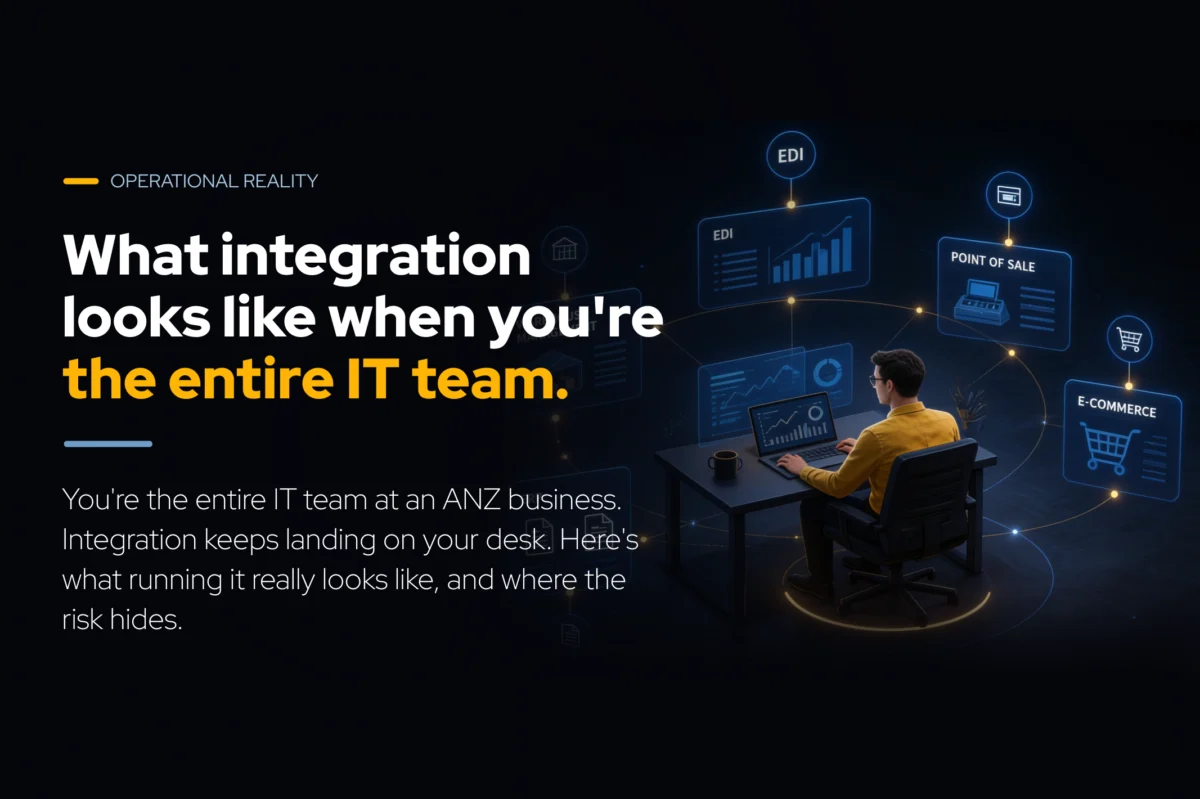
What Integration Looks Like When You’re the Entire IT Team
August 11, 2026
Peppol and EDI: what ANZ businesses need to know before the 2026 and 2027 deadlines
August 11, 2026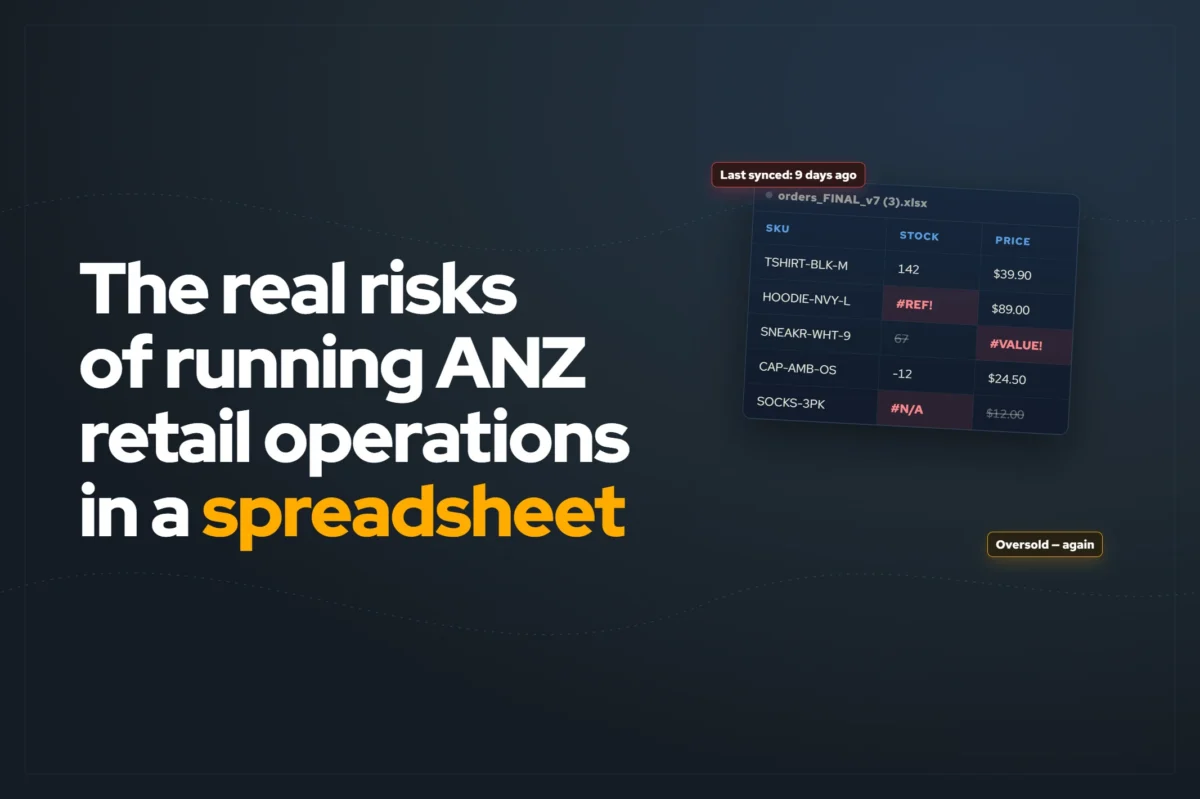
Most ANZ retail supplier has one. The spreadsheet. It started small, a single tab someone built years ago to track orders from one retailer. Nobody ever decided it would become the operating system for the business. It just kept absorbing jobs until it was.
Now the purchase orders from Woolworths land in an inbox, someone keys them into the workbook, someone else keys them into the ERP, the warehouse works off a printout, and invoicing happens from a third copy on the finance drive. Ask anyone how the operation runs and they’ll point at the systems. Watch how it actually runs and you’ll find the spreadsheet underneath everything.
It works, mostly. Which is exactly what makes the risk hard to see.
Every rekey is a small gamble
Manual order processing has a failure rate. Not a dramatic one, just a persistent one. A transposed quantity here, a wrong delivery date there, a product code that was right on the PO and wrong by the time it reached the warehouse.
At low volume the errors are annoyances. Someone catches them, fixes them, moves on. The trouble is that volume grows and the process doesn’t. Double the orders and you double the keystrokes, which doubles the chances of getting one wrong, while the person doing the keying has half the time to check their work.
The errors that slip through don’t announce themselves. They surface downstream, as a short delivery the retailer disputes, a pallet labelled for the wrong DC, an invoice that doesn’t match the PO. By then the cost isn’t the ten seconds it would have taken to catch. It’s the hours of untangling, and sometimes a chargeback.
Version control by filename
Orders_Master_FINAL_v3_USE_THIS.xlsx is a joke everyone makes and a risk nobody prices.
When the workbook lives on a shared drive, every person who touches it is a fork waiting to happen. Sales updates their copy. The warehouse has one open, locked, since 8am. Finance saved theirs to the desktop last Tuesday. Which version is true depends on who you ask and when you ask them.
Most weeks the copies converge and nobody notices. Some weeks they don’t, and the operation spends a morning working out why the picking list doesn’t match the order book. A corrupted file, an accidental sort that scrambled half the rows, an overwritten save. None of these are rare events in a workbook that ten people touch. They’re scheduled events with unknown dates.
The formula nobody remembers writing
Somewhere in the workbook there’s a formula doing something important, and nobody currently at the business knows why it works.
It was written by the person who built the sheet, adjusted during a retailer changeover in 2021, patched with a workaround when Coles updated a requirement. Then the person left. The logic stayed. The columns kept calculating.
That’s fine until a retailer changes their spec, which they do, regularly and without much ceremony. Woolworths adjusts a format, Foodstuffs updates a field requirement, and now someone has to open the sheet and work out which formulas the change touches. If they miss one, nothing errors. The sheet keeps producing numbers. They’re just quietly wrong, and they stay wrong until a delivery, an invoice or a buyer surfaces the damage.
Spreadsheets don’t fail loudly. That’s the real danger. A connection built into a proper system fails visibly and gets fixed. A broken formula just keeps calculating.
When the retailer asks for proof
Selling into the major ANZ retailers means being measured. DIFOT, order accuracy, ASN timeliness, invoice matching. When a number slips, the retailer wants to know what happened, and “let me check the spreadsheet” is not an answer that holds up.
A workbook can tell you what a cell says now. What it can’t reliably tell you:
- What the value was last Tuesday, before someone changed it
- Who changed it, and why
- Whether the order the warehouse shipped matches the order the retailer sent
- Which version of the truth the invoice was built from
This gap has a cost with a name: chargebacks. Non-compliance deductions in ANZ grocery typically run between one and five per cent of invoice value, and disputing them requires exactly the evidence trail a spreadsheet doesn’t keep. Operations teams end up wearing deductions they suspect are wrong, because proving it would cost more than paying it.
What the workbook was never built to carry
None of this is an argument that spreadsheets are bad. They’re brilliant at what they were built for: analysis, modelling, working things out. The risk isn’t the tool. The risk is asking it to be the transaction backbone of a retail operation, holding order flow, stock, compliance and invoicing together with formulas and discipline.
The job now has different requirements. Orders should move from the retailer into the ERP without being retyped. The warehouse should work from the same record as finance. When Coles changes a spec, one mapping gets updated in one place, visibly. When something fails, someone finds out before the customer does. That’s what retail process automation actually means in practice, and it’s the job an integration platform exists to do, so the spreadsheet can go back to being a spreadsheet.
Getting there isn’t a matter of buying software and hoping. It’s a matter of deciding the operation has outgrown the workbook, then working out the order of what to connect first.
If the spreadsheet is running your operation
You don’t need to rip anything out tomorrow. Plenty of the ANZ retail suppliers we work with started exactly here, with a workbook doing far more than anyone intended and an operations team quietly aware of it.
Flow connects retailer orders, ERPs, warehouses and invoicing for ANZ retail suppliers, and can run those integrations for you. Manual order processing goes away. The audit trail exists. The formula nobody remembers writing gets to retire gracefully.
Start with the flow that creates the most rework today: retailer orders, ASN creation, warehouse handoff, or invoice matching. That’s usually the first place to connect.
Talk to an integration specialist!